
Scenario offers a suite of cutting-edge models for transforming 2D images into fully textured 3D assets. While all models can convert flat images into meshes, they vary in geometry accuracy, texture realism, and performance speed.
This guide, updated to reflect the platform's state as of December 2025, helps you compare key models—specifically highlighting the latest Rodin, Tripo, and Hunyuan releases—to ensure you are leveraging the most current recommendations for high-fidelity asset creation.
Available 3D Generation Models on Scenario
Scenario supports a range of 3D generation models, each with unique strengths depending on your goals—whether you're aiming for high realism, fast iteration and lower costs, or stylized geometry. Below is a quick comparison table to review the key differences.
Model | Best For | Key Strengths | Speed & Requirements | Reference Images |
Ultra-HD fidelity and production-ready assets. | 1024 geometry resolution, 4K PBR textures, and clean topology. | Fast (~90s); high precision. | 1 | |
Accurate geometric reconstruction from multiple angles. | Superior spatial coherence and realistic lighting. | Moderate; requires multiple views. | Up to 4 | |
Transforming 2D sketches into 3D models. | Excellent for concept artists and quick drafts. | Fast. | 1 (sketch) | |
Automatic object part segmentation. | Generates separate meshes for further editing or animation. | Moderate. | 1 | |
Detailed, PBR-ready assets. | Smooth meshes and high-fidelity textures. | Ideal balance of speed and quality. | 1 | |
Scan-quality realism and professional workflows. | 10B parameter model; recursive part-based generation; quad-based meshes. | Approximately 60 seconds; high precision. | Up to 10 | |
High-quality realism for rigging. | Advanced geometry and multi-view precision. | Moderate to slow. | Up to 10 | |
Versatile 3D generation with multiple angles. | Supports Concat and Fuse modes for multiple objects. | Moderate. | Up to 10 | |
Lifelike 3D portraits and character heads. | Optimized for human subjects; facial coherence and volume stability. | Fast; watertight meshes with polycount control up to 2M faces. | 1–4 | |
High-fidelity 3D assets for games, AR/VR, and 3D printing. | Clean geometry; 3x faster processing and 4x faster convergence than v1. | Fast; supports resolutions up to $1536^3$ Pro. | 1–4 | |
Realistic human avatars and characters. | Focused on anatomy and facial fidelity. | Fast; watertight meshes. | 4 | |
Complex geometry and 3D printing. | Preserves fine details; ideal for complex surfaces. | Fast. | 4 | |
Enhanced geometric fidelity via multiple images. | Reduces hallucinations; maintains high-res PBR pipeline. | Slower than single-view. | 2–4 | |
Photorealistic single-object generation. | High-resolution textures and clean meshes. | Fast; ideal for objects. | 1 | |
Rapid 3D asset creation from photos. | High-quality mesh generation from a single 2D input. | Very fast. | 1 | |
Prompt-based 3D generation. | Direct conversion from text descriptions to 3D assets. | Very fast. | 0 (Text-only) | |
Refreshing or updating existing models. | Intelligent PBR texture mapping for existing meshes. | Very fast. | 1 + Mesh | |
Optimizing asset topology. | Enhances mesh structure and optimizes polygon counts. | Very fast. | 1 existing mesh | |
Preparing characters for animation. | Automatic skeletal rigging and weight painting. | Fast. | 1 existing mesh | |
Complex topologies and stylized characters. | 4B parameter model; native 3D VAE; handles transparency and open surfaces. | Fast; two-stage Diffusion Transformer (DiT) pipeline. | 1+ | |
Stylized or geometry-driven assets. | Excellent for toon shading, low-poly, or illustrative designs. | Fast with clean inputs. | 1–10 | |
Environmental assets and large props. | Voxel efficiency for terrain and urban structures; scales to 1024³. | Efficient; slow at high quality. | 1 | |
Part-based segmented generation. | Transforms images into multiple semantic meshes (wheels, panels, etc.). | Moderate. | 1 | |
Extracting props and assets from environmental photos. | Text-prompted reconstruction with point and box isolation tools. | Fast automated asset extraction. | 1 | |
Anatomical visualization and character foundations. | Standardized 3D body geometry for individuals or groups. | Fast reconstruction of anatomical structures. | 1 | |
Scene reconstruction and asset alignment. | Integrates body meshes and props into a shared 3D space. | Fast scene orchestration with perspective matching. | 1 | |
Voxel-style (blocky) assets. | Focused on block aesthetic (Minecraft/Sandbox style). | Fast. | 4 |
Which 3D Model Should You Use?
Choosing the right model depends on your technical priorities, whether you are optimizing for realism, speed, stylization, or reconstruction fidelity.
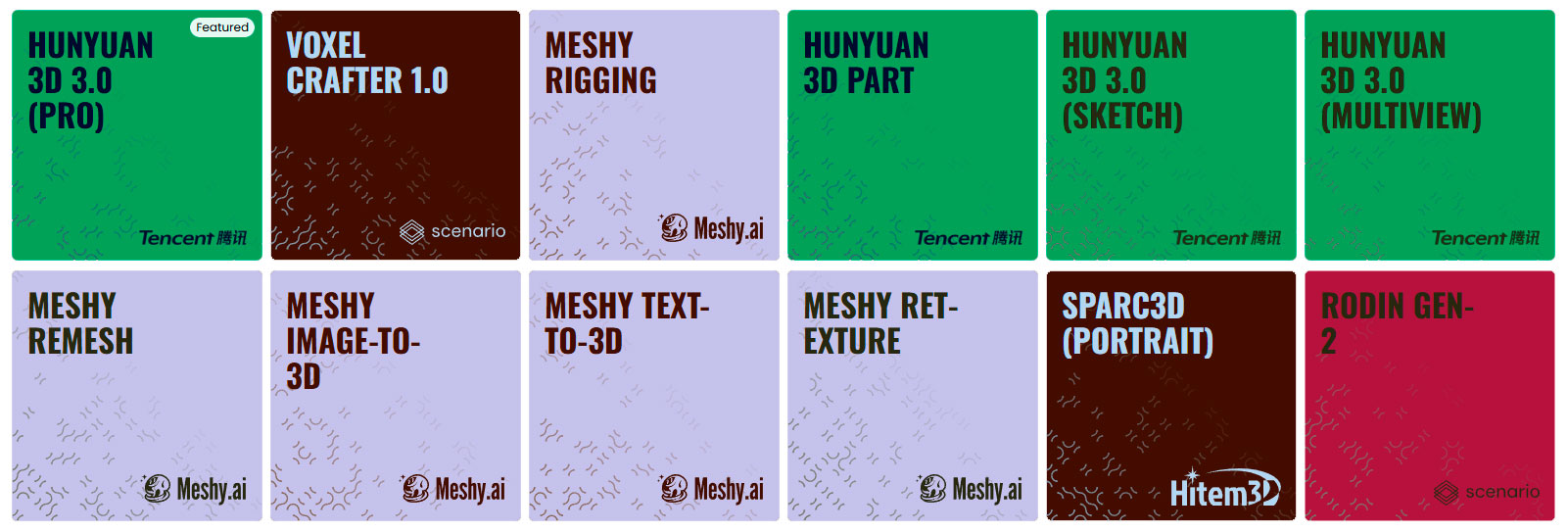
Hunyuan 3D (v3.0, v2.1, & Specialized)
Developed by Tencent, this family uses a flow-based diffusion model (Hunyuan3D-DiT) for geometry and high-resolution synthesis for textures.
Hunyuan 3D 3.0 (Pro/Multiview): The current flagship for high-resolution production.
Hunyuan 3D 3.0 (Sketch): Specifically tuned to interpret 2D sketches and line art into 3D volumes, making it ideal for early-stage concepting.
Hunyuan 3D Part: Automatically recognizes and generates separate meshes for different parts of an object (e.g., separating a chair's legs from its seat), simplifying the rigging and animation process.
Hunyuan 3D 2.1: A versatile, reliable version for high-quality assets with moderate processing times.
3D Models generated with Hunyuan 2.1
Sparc3D
Sparc3D 2.0 is optimized for watertight reconstruction and high-resolution structural integrity.
Sparc3D 2.0 (Portrait): Specialized for human subjects, focusing on facial coherence and volume stability.
Sparc3D 2.0 (General): Optimized for production assets and 3D printing with resolutions up to 1536³ Pro.
Sparc3D (Legacy): These original models remain available for rapid, standard-resolution prototyping.
Tripo 2.5
Optimized for photorealistic, object-centric assets.
Tripo 2.5 (Standard): Works from a single image, producing clean meshes with PBR support and HD resolutions (up to 2048x2048).
Tripo 2.5 Multi-View: Improves spatial consistency and reduces distortion by utilizing 2 to 4 images.
3D Models generated with Tripo 2.5
Rodin Family (Gen-2 and Gen-1)
Designed for high-fidelity multi-view image-to-3D synthesis.
Rodin Gen-2: Represents the state-of-the-art in surface realism, rivaling actual scans and offering optimized geometries for animation.
Rodin Gen-1: Versatile for using multiple reference images, supporting up to 10 images in Concat or Fuse mode.
Observe the gradual increase in mesh resolution from extra-low to high density in this other example:
PartCrafter (Generate in parts)
PartCrafter is the first open-source, image-to-3D generative model that transforms a single RGB image into several 3D meshes, semantically meaningful, all in one step. It can produces explicit meshes suitable for further editing, animation, or 3D printing—no segmentation or manual intervention required.
Unlike existing “single-block” AI mesh generators, PartCrafter separates your input object into defined components it can recognize (such as arms, wheels, panels, etc). These parts are cleanly segmented, each with its own geometry.
Works from just one image.
Generates 2 to 16 3D meshes.
Remove Background option.
Trellis
Trellis 2 utilizes a 4B parameter DiT pipeline for high-resolution PBR asset generation.
Trellis 2: Optimized for complex topologies and transparent materials with 1536³ resolution and 4K textures.
Trellis (Legacy): Based on SLAT architecture, this model remains effective for stylized designs and multi-view reconstruction (up to 10 images).
Direct3D-S2
Developed by NJU-3DV, Direct3D-S2 is designed for scalability. It uses Spatial Sparse Attention (SSA) to generate voxel-based models up to 1024³ resolution while remaining computationally efficient.
It produces acceptable detail for props or environments, though mesh fidelity can drop with increasing complexity.
Well-suited for terrain, urban layouts, or environmental structures where voxelization and structure outweigh texture polish.
Meshy Suite
Following the latest updates, the Meshy family provides a comprehensive workflow for rapid iteration:
Generation: Use Text-to-3D or Image-to-3D to create base assets in seconds.
Refinement: Apply Remesh to optimize the asset's performance for game engines.
Appearance: Use Retexture to apply professional PBR maps and materials.
Animation: Use Rigging to instantly prepare your character meshes for animation.
SAM3D Suite
SAM3D by Meta provides a modular pipeline for reconstructing assets and human subjects from 2D images.
SAM3D Objects: Isolates and reconstructs individual props from a scene using text, point, or box prompts.
SAM3D Human Body: Generates standardized 3D body geometry for anatomical visualization and character foundations.
SAM3D Align: Orchestrates and aligns body meshes and object props within a shared 3D space to maintain spatial relationships.
Voxel Crafter 1.0
Specifically designed to output "blocky" voxel art, perfect for games with a retro or sandbox aesthetic.
Conclusion: Choosing the Right Tool for the Task
The landscape of generative 3D is evolving rapidly, and the variety of models available on Scenario ensures that you have the right tool for every stage of your creative pipeline. Whether you are aiming for the high-fidelity, production-ready outputs of Hunyuan 3D 3.0 Pro and Rodin Gen-2, or the stylized, geometry-focused strengths of Trellis, the key to success lies in matching the model to your specific project requirements.
For high-end realism: Prioritize the newest generations like Hunyuan 3.0 and Rodin Gen-2.
For rapid prototyping: Tripo 2.5 and the Meshy Suite offer the best balance of speed and quality.
For specialized needs: Use Sparc3D for 3D printing or Hunyuan Part for modular assets ready for animation.
Because AI generation is inherently iterative, we recommend testing your primary reference image across multiple models. By comparing the geometry, texture resolution, and mesh topology side-by-side, you can find the perfect fit for your game, environment, or digital twin.
Was this helpful?