Ideogram V4: Text-to-Image with In-Image Typography
Last updated: June 5, 2026
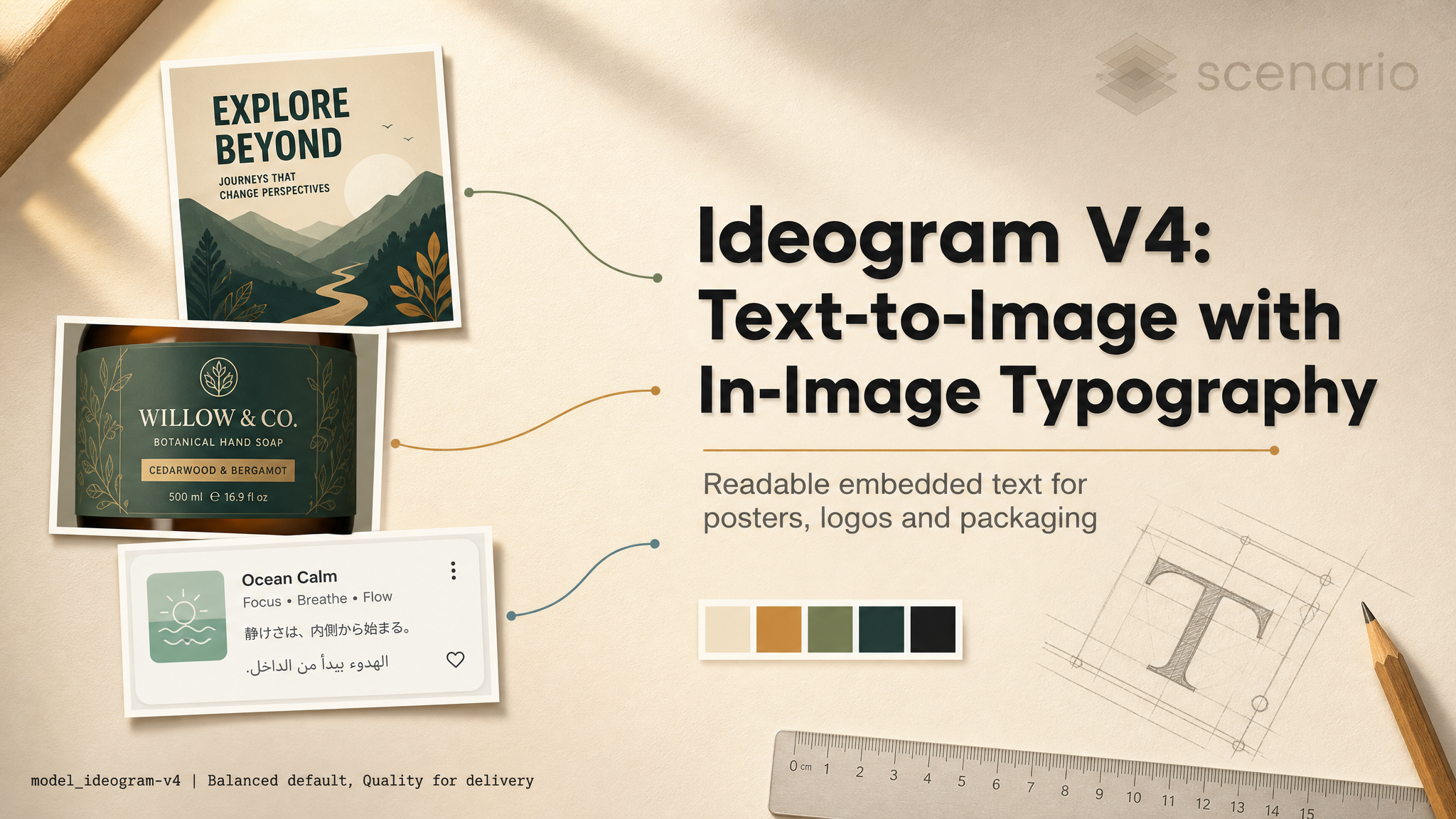
Ideogram V4 is Ideogram's latest text-to-image model on Scenario, built for design work where words must render correctly inside the frame. Posters, logos, menus, packaging, signage, and UI mockups with multilingual type are the core use case. Pick Turbo, Balanced, or Quality in a single model instead of switching between separate speed tiers.
The short version
Put the exact words in quotes and describe placement and typography in the prompt.
Default is Balanced at square HD (1024×1024). Use portrait or landscape presets for social and banner formats.
Turn off Prompt Expansion when you need the output to follow your wording literally.
How Ideogram V4 Works
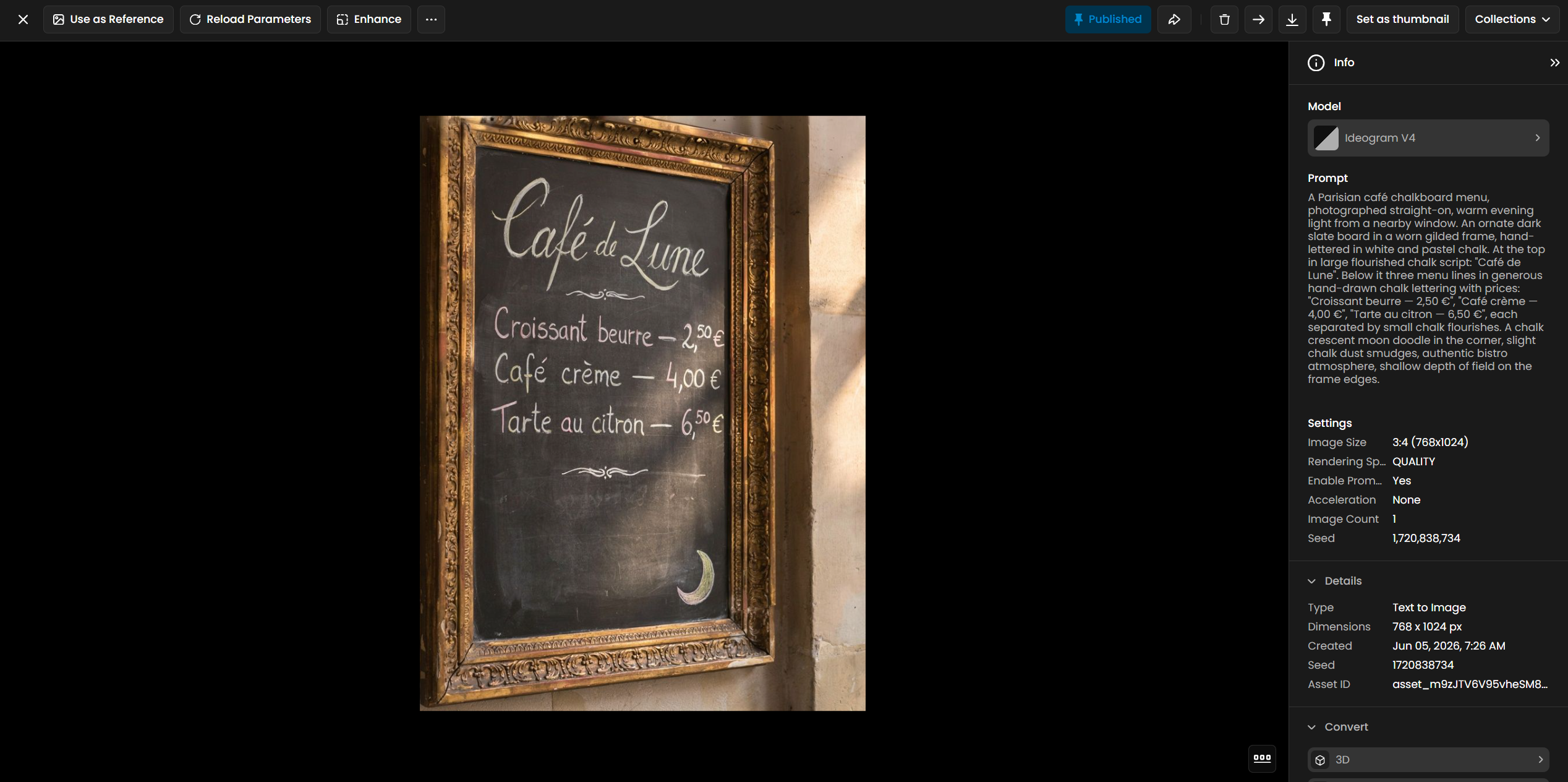
Ideogram V4 is text-to-image only on Scenario: write a prompt, set size and speed, generate. There is no reference-image input on this model page. The model specializes in rendering words as part of the artwork rather than as garbled texture.
Multilingual headlines, chrome movie titles, menu columns, and stylized scripts (including non-Latin calligraphy) are in scope. Combine a clear subject description with explicit typography instructions rather than relying on the model to invent the copy.
Prompt examples
Movie poster with chrome title:
Neon city skyline at dusk. Title text "MIDNIGHT RUN" in large chrome 3D letters across the top third, subtitle "Summer 2026" in small sans-serif below. Cinematic lighting, film grain.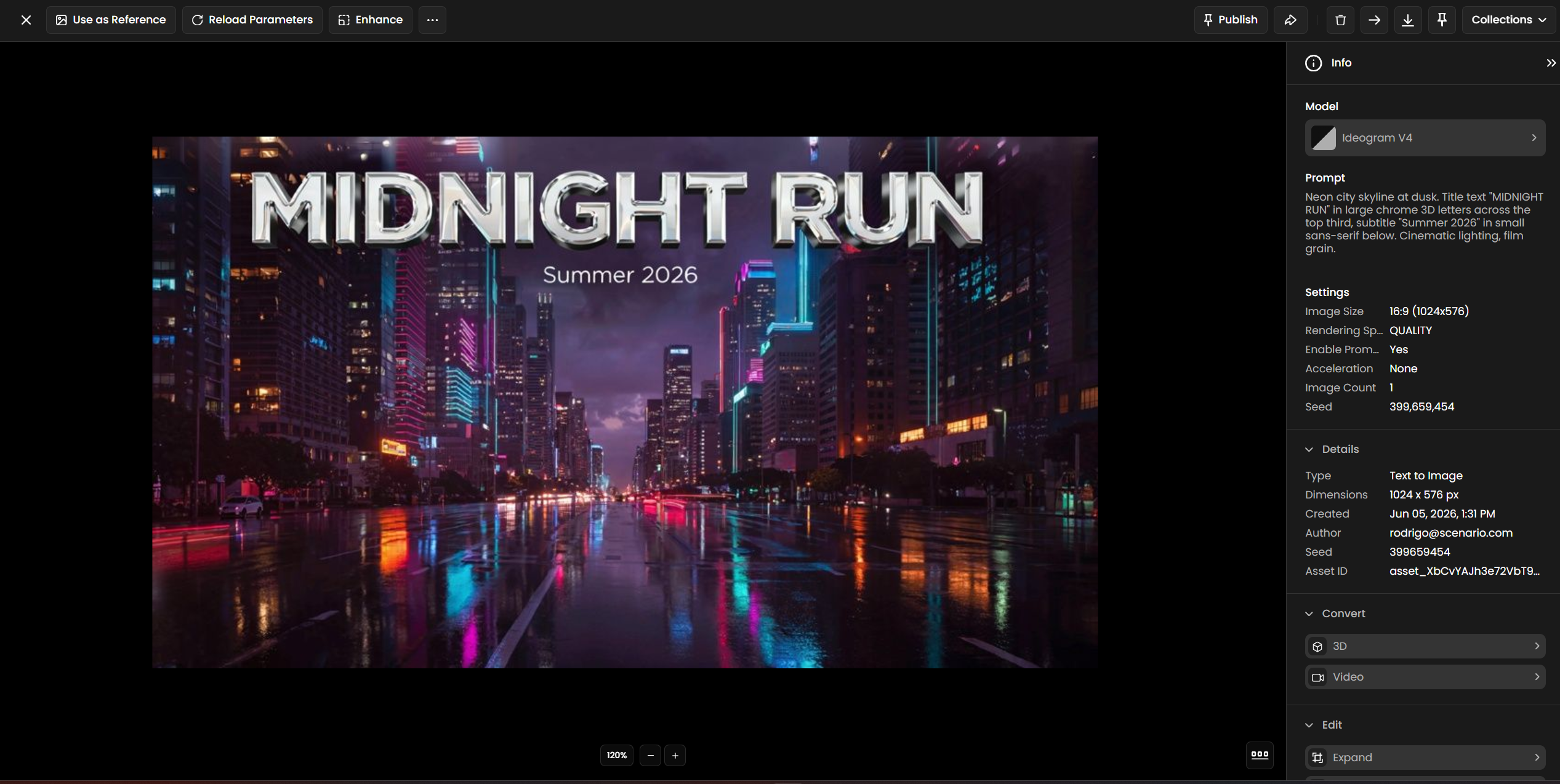
Restaurant menu board:
Chalkboard menu on a brick wall. Handwritten white chalk text listing three items: "Margherita $14", "Diavola $16", "Tiramisu $8". Warm tungsten light, shallow depth of field.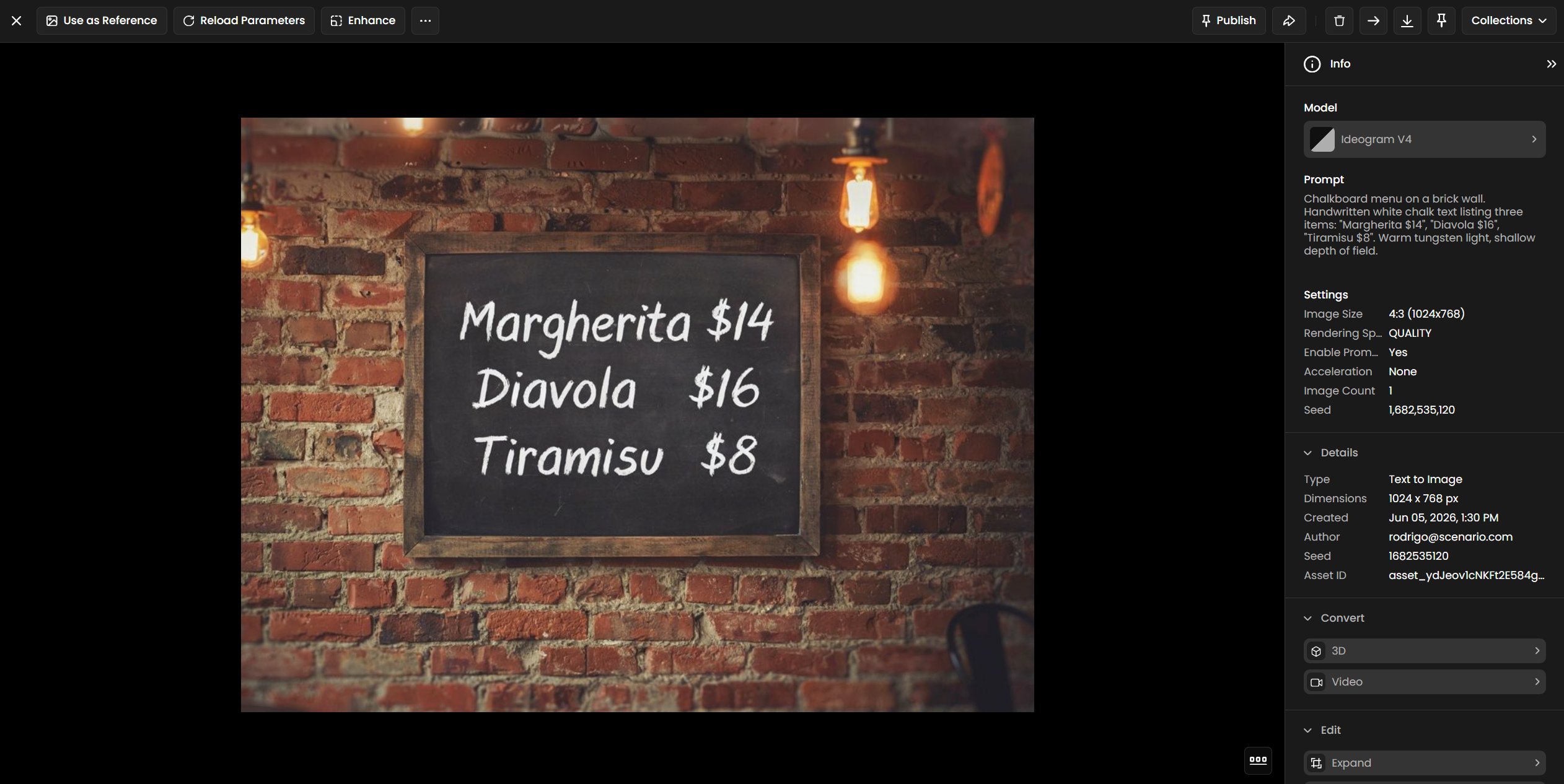
Product packaging:
Minimal skincare box on marble surface. Brand name "AURA" in thin uppercase serif centered on the front panel, tagline "Daily Glow Serum" beneath in smaller sans-serif. Soft studio lighting, pale green palette.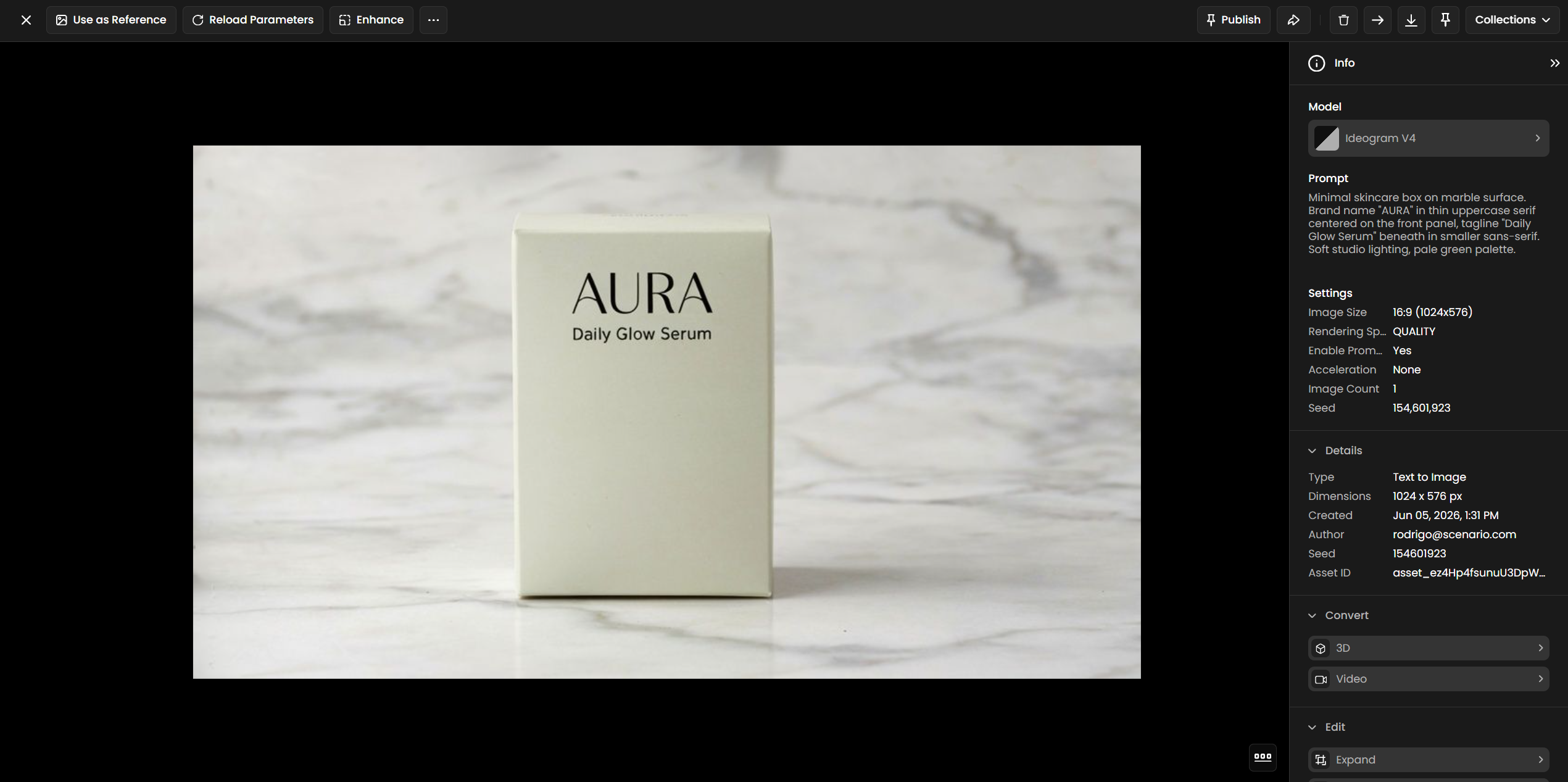
Content vs instruction trap: Style directions ("minimal, soft light") belong in the prompt. The literal words customers must read belong in quotes so they render as visible text, not as ignored instructions.
Parameters
Prompt (required). Up to 2,048 characters. Describe subject, style, mood, and any text that must appear in the image. Ideogram V4 is tuned for in-image typography: name the exact wording, placement, and letter style. Put literal copy in quotation marks.
Image Size. Six presets, default square_hd (1024×1024). Match the canvas to the destination:
portrait_16_9(9:16, 576×1024) for Stories and Reels,landscape_16_9(16:9, 1024×576) for banners and thumbnails,portrait_4_3andlandscape_4_3for print-adjacent layouts. Usesquare(512×512) only for fast drafts.Rendering Speed. Three tiers in one model:
TURBO: fastest, lightest detail (~4 CU dry-run baseline)
BALANCED (default): everyday posters and menus (~8 CU at square_hd, 1 image)
QUALITY: sharpest letterforms and texture (~12 CU per image before count multipliers)
Exact CU scales with size, speed, output count, and prompt expansion. Run a dry generation or check the estimate in the UI before large batches.
Enable Prompt Expansion. On by default. Scenario enriches short prompts with extra detail before generation. Keep it on for exploratory runs. Turn it off when the exact phrase, layout, or spelling must stay untouched.
Acceleration. Optional extra speed boost (None, Low, Regular, High). Default is None. Higher values shorten wait time but can soften fine type. Leave at None for hero typography work.
Image Count. 1 to 4 outputs per run. Each additional image adds cost. Useful for comparing layout or color variants from one prompt.
Seed. Optional integer (0 to 2147483647). Reuse a seed from a result you liked to reproduce the same composition when other settings stay identical.
Use Cases
Marketing and social: Posters, drop announcements, and quote cards with readable headlines.
Brand and packaging: Box mockups, bottle labels, and bag designs with logo type and legal copy.
Games: Title screens, quest boards, shop UI, and achievement badges with embedded lettering.
Film and previz: Temporary key art and one-sheet concepts with correct title treatment.
Education and signage: Infographics, wayfinding mockups, and multilingual classroom posters.
E-commerce: Promo banners and seasonal sale graphics with price callouts that spell correctly.
Tips for Better Results
Quote every string that must appear verbatim. Write
"OPENING NIGHT"in the prompt, not a paraphrase of the title.State placement and hierarchy. Say where the headline, subhead, and body copy sit (top third, centered panel, footer strip).
Disable Prompt Expansion for final spelling checks. Expansion can add words you did not specify.
Start at Balanced, upgrade to Quality for delivery. Use Turbo to iterate layout and composition cheaply.
Match Image Size to the publish target. Generate 9:16 natively instead of cropping a square later.
Generate four variants when the layout is right but the spelling is off. Small type errors are cheaper to fix with a new seed than manual retouching.
Keep acceleration at None for dense type. Speed boosts trade away fine letterform detail.
Known Limitations
Text-to-image only. No image-to-image on this model page. Use Ideogram 3 (Balanced) or siblings when you need a reference image.
Preset resolutions cap at 1024 px on the long edge. The native Ideogram 4 API supports wider aspect ratios and 2K output; Scenario exposes six fixed size presets instead.
Plain-text prompts only. Full Ideogram 4 JSON layout (bounding boxes, per-element color palettes) is not exposed on Scenario. Control layout through descriptive language and quoted copy.
Long passages still fail sometimes. Very dense paragraphs or tiny legal text may need simplification or a second pass at Quality speed.
Prompt Expansion can drift from briefs. Disable it when marketing or legal copy must match exactly.
Transparent assets need a follow-up tool. Use Generate Transparent or Remove Background for alpha outputs.
Plan access may apply. Access restriction level 50 on some workspaces. Check your plan if runs fail with a permissions error.
Open the model: Ideogram V4 on Scenario