MiniMax Hailuo Video: The Essentials
Last updated: October 5, 2026

MiniMax’s Hailuo series is a cutting‑edge family of AI video models that blend realistic motion with fine‑grained control across text‑to‑video and image‑to‑video workflows. Built for creators who need cinematic quality, these models can render dynamic scenes with precise physics, expressive characters and rich stylization while following detailed prompts. This article covers the full lineup: the current generation, MiniMax H3 Max (Hailuo 3.0), now the recommended default, and the previous generation, Hailuo 2.3 and Hailuo 2.0, still available and documented below for existing workflows.
The Current Generation: MiniMax H3 Max
MiniMax's newest video generation, marketed as Hailuo 3.0 and available on Scenario as MiniMax H3 Max, is now the recommended starting point for new work. Fal's post-trained tuning delivers stronger prompt adherence and richer detail than the 2.x generation below, across three models: H3 Max T2V (text-to-video), H3 Max I2V (image-to-video, with optional last-frame control), and H3 Max Reference to Video, a new capability this generation introduces: up to 9 reference images, 3 reference videos, and 3 reference audio clips per generation, for locking a specific subject, fusing a person with a product, transferring motion from a clip onto a new character, or animating scripted dialogue with lip-sync, none of which the Hailuo 2.x generation supports. A newer, faster tier, MiniMax H3 Max Turbo, adds even stronger prompt adherence and faster inference across the same T2V and I2V pair, best when a detailed, timestamped prompt needs to land exactly as written.
T2V, aggressive named camera move (barrel-roll orbit):
T2V, barrel-roll orbit camera, Aspect Ratio 21:9 · Open on Scenario
I2V, full 360-degree orbit from a still:
I2V, full 360-degree orbit, from a liquid-mercury fashion still · Open on Scenario
Reference to Video, scripted dialogue with lip-sync, a capability new to this generation:
A news anchor delivering a scripted line, matching mouth movement · Open this asset in Scenario
Full prompt guides, parameters, and dozens more examples for each: MiniMax H3: The Essentials (T2V, I2V, and the faster Turbo tier) and the MiniMax H3 Max Reference to Video model page.
Previous Generation: Hailuo 2.0 and 2.3
The 2.0 and 2.3 models below remain available on Scenario for workflows already built around them, and 2.0 still leads on extreme physics simulation and native 1080p. For new work, start with MiniMax H3 Max above.
Cinematic video generated using Minimax Hailuo 2.3
Hailuo 2.0 (Hailuo 02)
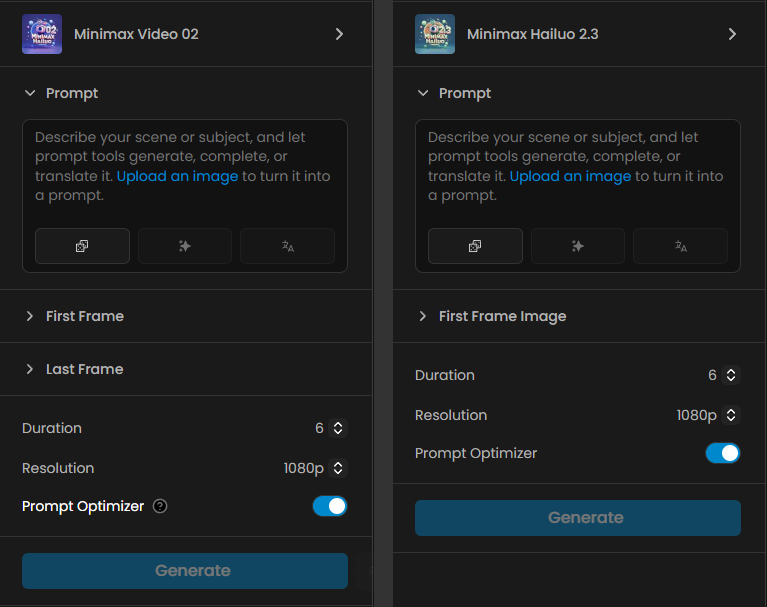
The Hailuo 2.0 model (also known as Hailuo 02) represents a major architectural leap over MiniMax’s earlier versions. It employs a Noise‑aware Compute Redistribution (NCR) framework that redistributes computational resources according to noise levels in the diffusion process, achieving 2.5× training and inference efficiency improvements. This efficiency allowed MiniMax to expand the model to three times as many parameters and train on a dataset four times larger than its predecessor. As a result, Hailuo 2.0 excels at state‑of‑the‑art instruction following and extreme physics simulation, accurately rendering complex movements such as gymnastics while maintaining high visual fidelity. It supports both text‑to‑video (T2V) and image‑to‑video (I2V) inputs, produces videos at 768p or native 1080p resolution, and offers clip lengths of 6 or 10 seconds. Hailuo 2.0 also includes last‑frame conditioning with supported durations of 6 or 10 seconds at 768p and 6 seconds at 1080p. Despite the increased complexity, it remains cost‑efficient thanks to the NCR architecture.
Hailuo 2.3
Released in October 2025, Hailuo 2.3 builds on the foundations of 2.0 while introducing significant enhancements in body movement, facial expressions, physical realism, and prompt adherence. The model further refines its understanding of physics and command following, enabling more fluid and natural character motions even with dynamic camera movements. Stylization options have expanded; Hailuo 2.3 supports anime, illustration, ink‑wash painting and game‑CG art styles, delivering vivid outputs across a wide range of aesthetics. MiniMax has also improved micro‑expression modeling, resulting in more lifelike facial performances and nuanced emotional shifts. Like its predecessor, Hailuo 2.3 is available in standard (quality) and fast (efficiency) variants. The latter offers quicker turnaround times and reduces batch creation costs by up to 50 % while maintaining strong fidelity. Unlike 2.0, however, last‑frame conditioning is not supported; videos are generated solely from the prompt or starting image. The 2.3 family generates at 768p or 1080p resolution (with 1080p limited to 6‑second clips) and handles both text and image inputs for the standard model, while the fast variant accepts image inputs only.
Model capabilities comparison
Key strengths and innovations
Advanced physics and motion control – Both Hailuo 2.0 and 2.3 are renowned for their ability to model complex physical interactions such as gymnastics and crowd movements. The 2.3 update further enhances fluidity and naturalness, achieving near‑photorealistic lighting and color consistency even under dynamic camera changes.
Precise instruction following – Hailuo models faithfully interpret detailed prompts, enabling creators to direct camera motion, character actions, and scene composition with high accuracy.
Rich stylization options – While Hailuo 2.0 focuses on realistic scenes, Hailuo 2.3 expands to anime, illustration, and game‑CG styles, offering a broader aesthetic palette.
Expressive characters – The 2.3 release delivers more natural micro‑expressions and emotional nuances, making close‑up shots and narrative scenes feel lifelike.
Efficiency & cost‑effectiveness – The NCR architecture in 2.0 improves efficiency by 2.5×, while 2.3 offers more capabilities at the same price point as 2.0 and introduces a Fast variant that reduces costs for batch creation by up to 50 %.
Multi‑modal inputs – Both models accept text prompts and images and can incorporate a starting image to guide composition.
Use cases and applications
Branded spokespeople and scripted dialogue – MiniMax H3 Max Reference to Video is the only model in this lineup that reliably lip-syncs a scripted line, so a locked character can deliver dialogue on camera.
Product-in-hand e-commerce reveals – H3 Max Reference to Video fuses a person and a separate product shot into one authentic scene, useful when a real product needs to appear worn or held without a physical shoot.
Dynamic choreography & dance – Hailuo 2.3’s improved motion capture and physics engine make it ideal for dance sequences and fluid choreography. TikTok creators and social video producers can generate captivating clips with natural rhythm and motion.
Character‑driven narratives – With enhanced micro‑expressions and facial realism, Hailuo 2.3 excels in storytelling scenes where emotions and dialogue matter. Hailuo 2.0 also supports narrative scenes but may require more post‑processing for subtle expressions.
E‑commerce & product advertising – The 2.3 model’s ability to simulate natural lighting, depth of field, and smooth camera pans allows marketers to create premium product videos, from lifestyle ads to CGI and unboxing experiences. 2.0 provides strong physics but offers fewer art‑style options.
Anime & illustrative content – Hailuo 2.3’s expanded stylization capabilities enable creators to produce anime‑style trailers, illustrated shorts, and game concept art.
Complex action & physics scenes – Hailuo 2.0 remains the go‑to for scenarios requiring extreme physics, such as gymnastics, parkour, or action sequences.
Cinematic films and AI storytelling – Both models can generate cinematic shots with dynamic camera moves and high resolution. Hailuo 2.3’s improvements blur the line between AI‑generated videos and live‑action filmmaking.
Prompting guide & best practices
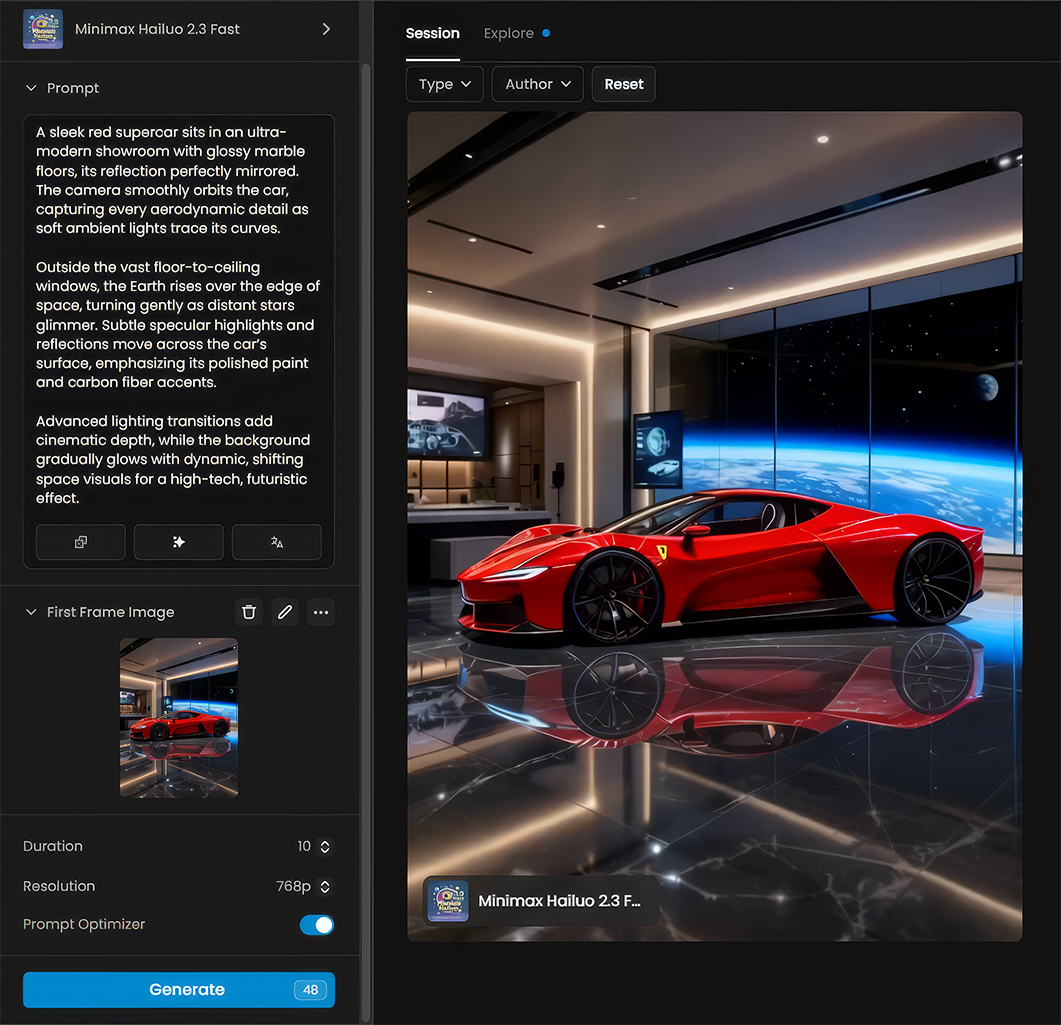
To achieve consistent, high‑quality results with Hailuo models, treat your prompt like a director’s note. Consider the following guidelines:
Describe the action clearly – Explain what happens in each shot using present‑tense verbs. Mention subject motions, interactions, and camera movements (pan, tilt, zoom, dolly).
Specify style & atmosphere – Include references to art styles (e.g., anime, ink‑wash, cinematic), lighting conditions, color palette, and mood. For Hailuo 2.3, these details help the model choose the appropriate stylization.
Emphasize physics and expressions – When using Hailuo 2.3, note desired micro‑expressions or emotional beats; with Hailuo 2.0, focus on describing complex physical actions and interactions.
Use scene anchors – For Hailuo 2.0, take advantage of last‑frame conditioning by providing a target image for the sequence’s conclusion.
Keep prompts coherent and concise – Overly long or conflicting instructions can confuse the model. Break multi‑shot sequences into separate sentences within the same paragraph to maintain temporal flow.
Iterate and refine – Start with shorter clips (6 s) to test your prompt, then adjust details or duration as needed. Use the Fast variants for quick iterations and switch to the quality versions once you’re satisfied with the composition.
On H3 Max Reference to Video, name every reference's job up front. Open with "Use Image 1 as..., Use Image 2 as..." before describing the action; the model follows explicit role assignment far more reliably than an unlabeled reference.
Put dialogue in quotation marks on Reference to Video. "She says: '...'" reads as a lip-sync cue; plain narration describing speech does not animate the mouth the same way.
Pros and cons summary
Hailuo 2.0
Pros
Performs state‑of‑the‑art instruction following and physics simulation for complex scenarios.
Native 1080p output and 10‑second clips; supports both text and image inputs.
Last‑frame conditioning allows precise control over the final frame.
More efficient architecture (2.5× improvement) reduces compute cost.
Cons
Generation speed is still improving; rendering longer clips can take time.
Stylization options are limited compared with Hailuo 2.3.
1080p clips are capped at 6 seconds; longer durations require lower resolution.
Hailuo 2.3 (Quality)
Pros
Enhanced motion, physics, and micro‑expressions yield lifelike visuals.
Supports diverse artistic styles, including anime, illustration, and game CG.
Improved prompt adherence and object motion response.
Cons
Last‑frame conditioning is unavailable.
1080p clips are limited to 6 seconds.
Requires more computation than the 2.3 Fast variant.
Hailuo 2.3 Fast
Pros
Delivers faster generation and reduced cost, up to 50% lower than the quality version.
Retains improved motion and stylization features of Hailuo 2.3.
Ideal for quick previews, batch content, and lightweight devices.
Cons
Accepts image inputs only.
Does not support last‑frame conditioning and may offer slightly lower fidelity than the quality version.
1080p duration is capped at 6 seconds.
Limitations & considerations
Clip length – All Hailuo models are currently limited to 10 seconds per video; longer narratives require stitching multiple clips.
Hardware requirements – Generating 1080p video, especially on the quality versions, requires substantial GPU resources. Using cloud services or provider APIs can offload this requirement.
Alignment & stability – While Hailuo 2.3 improves adherence and stability, occasional inconsistencies or artifacts can occur; iterative prompt refinement and post‑editing remain important.
Reference-driven consistency and dialogue are current-generation only. Hailuo 2.0 and 2.3 take only a text prompt or a starting image; for multi-reference fusion, motion transfer, or lip-synced dialogue, use MiniMax H3 Max Reference to Video instead.
H3 Max caps at 768P, with no native 1080p tier. Hailuo 2.0 remains the choice in this lineup for native 1080p output.
Conclusion
MiniMax’s Hailuo lineup pushes the boundaries of AI‑generated video by combining detailed physics, expressive characters and flexible inputs, and now spans two generations on Scenario. MiniMax H3 Max is the current generation and the recommended default: fal's tuning gives it the strongest prompt adherence in the lineup across T2V and I2V, and its third model, H3 Max Reference to Video, is the only one here that locks a subject across multiple references, transfers motion from a clip onto a new character, or animates scripted dialogue with lip-sync. A faster H3 Max Turbo tier trades a touch of headroom for speed and even tighter prompt adherence on T2V and I2V. The previous generation remains available for specific needs: Hailuo 2.0 still leads on extreme physics simulation and native 1080p output, and Hailuo 2.3 (quality and fast) offers a wider range of art styles at the 2.0 price point. Start new work on H3 Max; reach for 2.0 or 2.3 when an existing workflow depends on their specific strengths.