Kling Video Models - The Essentials
Last updated: November 19, 2026
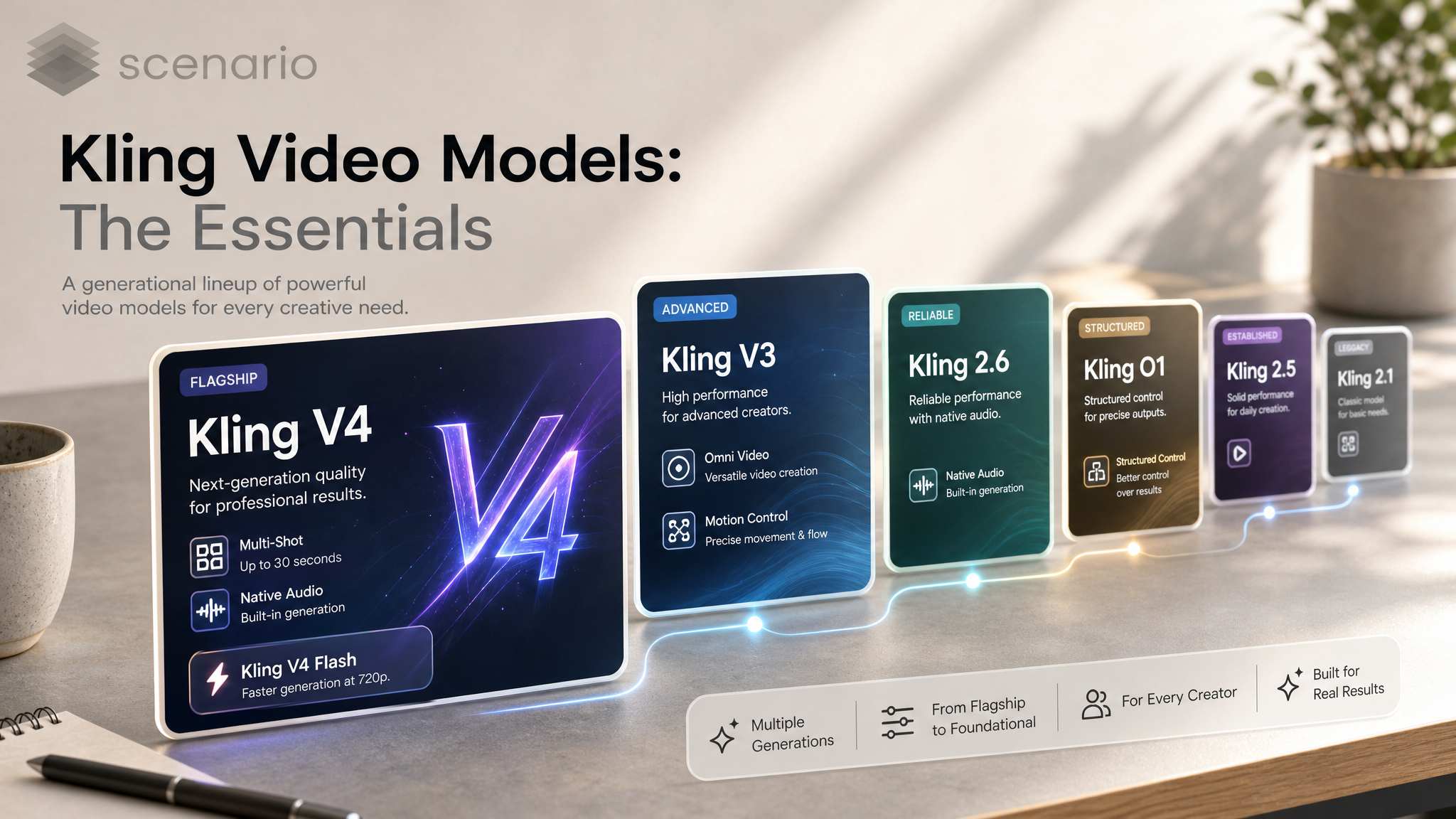
Kling by Kuaishou is a family of video models for text-to-video, image-to-video, reference-based generation, video editing and motion transfer, most with native audio. The newest generation, Kling V4, is the place to start: clips of up to 30 seconds at 720p or 1080p, multi-shot sequences directed in one generation, and Kling V4 Flash, a faster 720p model that handles every mode on its own. This article covers Kling V4 in depth, then the Kling V3 models that are still current, and closes with the older generations, most of which Kling V4 now replaces.
Which Kling Model Should I Use?
Model | You provide | Use it to |
|---|---|---|
Kling V4 Flash | A text prompt, plus an optional start image, reference images, reference videos or a video to edit | Make storyboards, social clips and large batches quickly at 720p |
Kling V4 T2V | A text prompt or a list of shots | Invent a scene from scratch, at up to 1080p and 30 seconds |
Kling V4 I2V | A start image, optional end image | Animate an approved still, or land on a specific final frame |
Kling V4 - Reference to Video | Images, videos and elements | Keep the same character, product or place across clips |
Kling V4 - Video Editing | A source video, optional images and elements | Change a clip without regenerating its motion |
Kling V3 Omni Video | Text, start and end images, reference images or a reference video | Generate in native 4K, or restyle a clip with a Feature or Base reference video |
Kling V3 Motion Control (Std and Pro) | A character image and a reference video | Make a character perform the exact motion of a video |
Kling V3 T2V 4K and Kling V3 I2V 4K | A text prompt, or a start image | Deliver text-to-video or image-to-video in native 4K |
Kling V4
Kling V4 Flash: the newest. One model for every mode, chosen by what you give it: text, a start frame, reference images or reference videos, or a video to edit. 720p clips of 3 to 20 seconds with native audio.
Kling V4 T2V: text-to-video at up to 1080p and 30 seconds, in 16:9, 9:16, 1:1 or 21:9.
Kling V4 I2V: image-to-video from a start frame, with an optional end frame. The output follows the start image's aspect ratio.
Kling V4 - Reference to Video: keeps characters, objects and settings consistent using reference images, reference videos and elements.
Kling V4 - Video Editing: edits an existing video of 3 to 30 seconds with natural-language instructions while keeping its original motion.
Every Kling V4 model makes native audio: there is no Generate Audio switch, so describe the voices, effects and ambience you want in the prompt.
Kling V4 Flash
Kling V4 Flash picks its mode from your inputs. A prompt alone makes a clip from scratch, a start image becomes the first frame, reference images bring in characters, objects, scenes or style, reference videos bring in motion, camera work or style, and a video to edit keeps its length and framing while the prompt changes what you ask. Every clip is 720p with native audio, so describe the sound you want too.
Point at your inputs from the prompt with @image_1, @image_2 and so on (the start image first, then the reference images) and @video_1, @video_2 (the video to edit first, then the reference videos). These names differ from the four main models, which use @Image1 and @Video1.
Kling V4 Flash has no resolution choice, no Multi Prompt, no end frame and no elements; use the main models for those.
Text to video. Write the scene, the camera move and the sound in one prompt, and pick an aspect ratio. Prompt:
An ultra-wide cinematic shot of a camel caravan of six camels with loaded saddlebags and three robed travelers crossing a vast golden sand-dune desert at sunrise, long shadows stretching across the rippled dunes, a lone hawk gliding overhead. The camera glides slowly sideways at ground level, then rises to reveal the full length of the caravan against a huge pink and orange sky. Soft wind blowing sand off the dune crests, camel bells, muffled footsteps in sand and a low breeze.Kling V4 Flash, text to video, 21:9, 10 seconds: a camel caravan crossing the dunes at sunrise, with wind and camel bells · Open on Scenario
Timing cues work too. Prompt:
An extreme macro of a single drop of deep blue ink falling into a clear glass tank of water against a white background. On impact it blooms into slow, silky tendrils that curl and fold into each other, then a second drop of magenta ink follows at the five second mark and the two colors swirl together into soft violet filaments, tiny bubbles rising. The camera drifts slowly closer and slightly down. Clean studio light, high detail, a soft low hum and gentle water bloops.Kling V4 Flash, text to video, 1:1, 12 seconds: blue, then magenta ink blooming in water, in extreme macro · Open on Scenario
Start frame. Set a start image and describe what happens next. The clip opens on your image and follows its aspect ratio. Prompt:
@image_1 comes alive: the astronaut in the orange retro suit slowly turns her head from the pale moon toward the camera, then takes a first careful step down the rust-red ridge, boots kicking up fine red dust that drifts in the low gravity. She raises one gloved hand to shield her helmet visor from the setting sun, a faint wind sweeping dust across the dunes below. The camera begins on a low angle and slowly pushes in then arcs around her to a side profile as golden light flares across the helmet glass. Soft breathing inside the helmet, a low desert wind and crunching boot steps.Kling V4 Flash, start frame, 10 seconds: an astronaut on a red ridge turns and steps down as the camera arcs around her · Open on Scenario
Reference images. Add characters, animals or objects as reference images and say who is who in the prompt. Prompt:
@image_1 is the astronaut in the retro orange suit and @image_2 is the snow leopard. On a hushed mountain plateau at first light, the astronaut kneels in the snow and slowly holds out an open gloved hand while the snow leopard approaches with patient, curious steps, sniffs the glove, and then rests its chin against her helmet visor in a quiet moment of trust. The camera starts wide, pushes in slowly over the snow and ends in a tender close-up of the visor and the leopard's pale eyes. Thin cold light, drifting snow crystals, muffled breath inside the helmet and soft wind.Kling V4 Flash, two reference images, 16:9, 10 seconds: the astronaut and a snow leopard meet on a snowy plateau · Open on Scenario
Reference video. Borrow a camera move or a motion from a reference video, and combine it with a start frame. Prompt:
@image_1 is the snow leopard on the snowy ridge. Reproduce the camera work of @video_1: a smooth slow dolly back from a close detail to a wide reveal. Here, the leopard starts in a close-up of its pale eyes and snow-dusted whiskers, then the camera dollies back to reveal the leopard standing on the rock with the sunlit peaks behind, and the leopard slowly lowers into a crouch and bounds off to the left out of frame. Cold dawn light, wind and soft snow crunch.Kling V4 Flash, start frame and a reference video, 10 seconds: the snow leopard filmed with the reference's dolly-back reveal · Open on Scenario
Video editing. Set a video to edit, say what to keep and what to change. The output keeps the source's length and aspect ratio. Prompt:
Edit @video_1: keep the lighthouse keeper's walk, the path, the lantern light and the camera crane exactly as they are, but change the weather and time to a bright stormy afternoon: heavy rain slanting in from the sea, dark grey clouds with a break of pale light on the horizon, wet shining rocks, and change the keeper's slicker from yellow to deep blue.Kling V4 Flash, video edit, 9:16, 12 seconds (the source's length): a lighthouse keeper's walk moved into a rainstorm, the slicker turned blue · Open on Scenario
Kling V4 T2V, I2V, Reference to Video and Video Editing
The four main models make clips of up to 30 seconds at 720p or 1080p, with native audio.
Directing a sequence with Multi Prompt. All three generation models (T2V, I2V and Reference to Video) accept Multi Prompt: a list of shots, each with its own prompt (up to 512 characters) and duration (1 to 30 seconds). When Multi Prompt is set, it replaces the main prompt and the video lasts the sum of the shot durations. Describe one scene per shot and keep each shot self-contained.
Using reference images, videos and elements. In Reference to Video and Video Editing, point at your inputs from the prompt: @Image1, @Image2, @Video1 and @Element1. In Video Editing, the source video is @Video1. For example: "Place @Element1 on the rooftop from @Image1, walking toward the camera at sunset."
An element is a character or object defined by a frontal image plus one to three images from other angles. You can add up to seven elements per generation.
Text to video with Multi Prompt. Six shots of five seconds each make a 30-second dialogue scene with the same two characters in every shot. Shots:
Shot 1 (5 s): Wide shot of a stone chess table in a city park at dusk, autumn leaves: an old chess master in a tweed cap and gray beard sits across from a young street hustler in a green bomber jacket with a cocky grin. Sound: park ambience, distant traffic.
Shot 2 (5 s): Over-the-shoulder on the young hustler: he slams a knight down and says in English, fast and cocky, "you've got three moves, old man. Maybe two." Sound: wooden clack of the piece.
Shot 3 (5 s): Close-up of the old chess master: he smiles slowly, eyes on the board, and says in a calm, gravelly voice, "in my day, we counted the moves we had left. Not the ones they had."
Shot 4 (5 s): Insert close-up of the board: the old man's wrinkled hand slides a bishop diagonally across the board and stops beside the young man's king.
Shot 5 (5 s): Close-up of the young hustler: his grin fades, he leans in, stares at the board, and whispers, "no way." Sound: a gust of wind, leaves skittering.
Shot 6 (5 s): Wide shot again: the old master stands, tips his cap, and says, "same time tomorrow," then walks off along the leaf-covered path while the young man stays frozen over the board. Sound: footsteps on leaves. No subtitles.
Kling V4 T2V, Multi Prompt, 16:9, generated at 1080p, 30 seconds: a chess game in a park, told in six shots with dialogue · Open on Scenario
Image to video with Multi Prompt. One start image of a boy on a beach becomes a five-shot, 30-second story. The output follows the start image's aspect ratio. Shots:
Shot 1 (6 s): Wide shot: the boy in the striped shirt walks along the waterline at dawn and spots a green glass bottle rolling in the surf. Sound: waves, gulls.
Shot 2 (6 s): Close-up: the same boy kneels, pulls the cork out and slides out a rolled, yellowed letter tied with string. Sound: cork pop, paper rustle.
Shot 3 (6 s): Over-the-shoulder close-up: he unrolls the letter; it is a hand-drawn map of the coast with a red cross on a rocky island visible offshore. Sound: wind, his excited breath.
Shot 4 (6 s): Medium shot: he runs to an old fisherman mending nets by a blue boat and holds up the map; the fisherman squints, then laughs and nods toward the boat. Sound: running footsteps on sand, laughter.
Shot 5 (6 s): Wide shot from the breakwater: the fisherman rows the blue boat out toward the rocky island at sunrise, the boy at the bow pointing ahead. Sound: oars in the water, gulls, a hopeful guitar melody. No subtitles.
Kling V4 I2V, one start image and Multi Prompt, generated at 1080p, 30 seconds: a message in a bottle leads a boy and a fisherman out to sea · Open on Scenario
Reference to Video with two reference videos. Give each input its own job in the prompt: one reference video for the body motion, one for the camera, and a reference image for the character. Prompt:
Use @Video1 only for the body motion and timing: the toprock, the drop into footwork, the backspin and the freeze. Use @Video2 only for the camera: a smooth 360-degree orbit around the dancer at chest height. Use @Image1 for the character: the grandmother with short white hair, gold hoops, purple tracksuit, white high-tops and backwards cap. She performs the whole breakdance routine on a rooftop basketball court at sunset while the camera orbits her once, a small crowd cheering from the edges. Photoreal. Audio: a hip-hop beat, sneaker squeaks, crowd cheers.Kling V4 - Reference to Video, one reference image and two reference videos, 16:9, generated at 1080p, 10 seconds: a grandmother breakdances on a rooftop while the camera orbits her · Open on Scenario
Video Editing with two elements. Swap two people at once and say what must stay the same. Prompt:
Edit @Video1. Replace the runner on the left with @Element1, the woman with the long silver ponytail in the orange running jacket, and replace the runner on the right with @Element2, the young man with dark curly hair in the mustard yellow hoodie. Match their faces and outfits exactly, with the same running motion, chatting and timing. Keep everything else unchanged: the riverside path, the park and the camera.Kling V4 - Video Editing, two elements, generated at 1080p, 10 seconds: both runners replaced while the path, the park and the camera stay as they were · Open on Scenario
Kling V4 Parameters
prompt
The text description. Kling V4 Flash: required, up to 11,000 characters, with inputs named @image_1 and @video_1 as in the examples above. The four main models: up to 2,048 characters, required unless Multi Prompt is set (Video Editing always requires it).
multiPrompt
Kling V4 T2V, I2V and Reference to Video only: shots with per-shot prompts and durations, as described above. Not available in Kling V4 Flash or Video Editing.
duration
Length of the clip. Kling V4 Flash: 3 to 20 seconds (default 5), ignored when a video to edit is set, since the output keeps that video's length (the lighthouse edit above lasts 12 seconds because its source did). The four main models: 3 to 30 seconds (default 5), ignored when Multi Prompt is set; in Video Editing, leave it empty to match the source video, or pick 3 to 30 seconds.
resolution
The four main models only: 720p or 1080p (default 1080p). Test ideas at 720p and a short duration first. Kling V4 Flash always makes 720p.
aspectRatio
16:9, 9:16, 1:1 or 21:9 (default 16:9). Kling V4 Flash ignores it when a start image or a video to edit is set; the camel caravan above used 21:9 and the ink drop 1:1. Kling V4 - Reference to Video also offers auto, which adapts to your references. Not available in Kling V4 I2V, which follows the start image.
startImage / endImage
Kling V4 Flash: an optional start image, the first frame, whose aspect ratio the output follows (the astronaut example above), up to 30 MB; no end image. Kling V4 I2V requires a start image and accepts an optional end image. In Kling V4 - Reference to Video, the start image is optional and counts toward the reference image limit. Up to 30 MB each.
referenceImages
Kling V4 Flash only: characters, objects, scenes or style, as in the snow leopard example above. Up to 10 images in total, the start image included, 30 MB each.
images
Kling V4 - Reference to Video and Video Editing only: up to 10 reference images.
referenceVideos
Kling V4 Flash: motion, camera work or style, as in the camera move example above. 3 to 20 seconds each, up to five videos and 20 seconds in total, the video to edit included, 300 MB each. Kling V4 - Reference to Video: up to five reference videos of 3 to 30 seconds each.
video
Kling V4 Flash: the video to edit, 3 to 20 seconds, up to 300 MB; the output keeps its length and aspect ratio (the lighthouse example above). Kling V4 - Video Editing: the clip to edit, 3 to 30 seconds, 700 to 4,553 pixels per side, up to 300 MB.
Kling V3
Kling V3 introduced multi-shot prompting and elements to the family. Three Kling V3 lines have no Kling V4 counterpart and stay current: Omni Video, Motion Control and the 4K models. Kling V3 T2V and I2V are deprecated in favor of Kling V4.
Kling V3 Omni Video
Kling V3 Omni Video handles text-to-video, image-to-video and video-to-video in one model. Use it when you need native 4K, or a reference video that restyles or edits a clip.
Modes: Standard makes 720p, Pro 1080p (the default) and 4K native 4K. The 4K mode does not accept a reference video.
Frames and references: an optional start image, an end image (which needs a start image), and up to seven reference images for characters, scenes or styles (four when a reference video is set).
Reference video: 3 to 10 seconds. Set it to Feature to borrow its style or camera motion, or to Base to edit and restyle the clip itself. In Base mode the duration setting is ignored.
Audio: Generate Audio is off by default and cannot be combined with a reference video. Keep Original Sound keeps the reference video's audio (on by default).
Duration and format: 3 to 15 seconds, in 16:9, 1:1 or 9:16.
Multi Prompt: up to six shots of at least one second each, entered as a JSON array of shots with a prompt and a duration. The shot durations must add up to the duration setting, and the main prompt box must stay empty.
Kling V3 Omni Video with reference images: a cartoon character with headphones cycles through expressions while keeping her design
Kling V3 Omni Video, Multi Prompt: a tense four-shot exchange cut between close-ups and a two-shot
👉 Kling V3 Omni Video: The All-in-One Cinematic Powerhouse
Kling V3 Motion Control (Std and Pro)
Kling V3 Std - Motion Control and Kling V3 Pro - Motion Control transfer the motion of a reference video onto a character image. Std is the faster option for prototyping; Pro handles intricate hand movements and complex body interactions better.
Character image: the character who performs the motion.
Reference video: the motion to copy, as .mp4, .mov, .webm, .m4v or .gif.
Character Orientation: image (the default) keeps the orientation of the character image; video follows the person in the reference video, which helps when the starting poses differ a lot.
Keep Original Sound: keeps the reference video's audio (on by default).
Elements: up to four, each a frontal image plus up to three more views, named
@Element1and so on in the prompt.Prompt: optional. Use it for lighting, setting and style so the character blends into the scene.
Kling V3 Motion Control: a cartoon lifeguard copies the arm-raising dance from a park video
Kling V3 Motion Control: an armored soldier takes on the walk of a reference video shot in a burning corridor
👉 Kling V3 Motion Control: The Essentials
Kling V3 T2V 4K and Kling V3 I2V 4K
Kling V3 T2V 4K and Kling V3 I2V 4K render Kling V3 text-to-video and image-to-video in native 4K. Kling V3 T2V 4K makes 3 to 15 seconds in 16:9, 9:16 or 1:1, with native audio on by default, Multi Prompt (shots of 3 to 15 seconds, planned by you with Customize or by the model with Intelligent), a negative prompt and a guidance scale.
Kling V3 T2V and I2V (Deprecated)
Kling V3 T2V and I2V, in Standard and Pro, are replaced by Kling V4 T2V and Kling V4 I2V. They introduced the Multi-Prompt system (up to five shots in one generation), start and end images in single-prompt mode, and elements.
Kling V3, Multi Prompt: a desert buggy chase cut across several shots
Kling V3 I2V: a character in a navy armored suit brought to life from a start image
Earlier Kling Models
These generations are kept for existing projects. Most are deprecated; pick a Kling V4 model for new work.
Kling 2.6
Kling 2.6 brought native audio to the family: voices, sound effects and ambience generated with the video in one pass. Kling 2.6 T2V (Pro) and I2V (Pro) are replaced by Kling V4 T2V and I2V, and Kling V2.6 Motion Control by Kling V3 Pro - Motion Control.
Kling 2.6 with native audio: a singer with a guitar performs in a blue-lit club, her voice and the room sound generated with the video
Kling O1
The Kling O1 family focused on structured control and editing. Kling O1 I2V, O1 Reference Images and O1 Video Editing are replaced by Kling V4 I2V, Kling V4 - Reference to Video and Kling V4 - Video Editing. Kling O1 Reference Video has no direct replacement and stays available: it generates new scenes guided by a source video, keeping its motion and style.
👉 Kling O1 Family - The Essentials
Kling 2.5
Kling 2.5 Turbo made generation faster than earlier versions. Kling 2.5 T2V (Pro), I2V (Pro) and I2V (Standard) are replaced by Kling V4 T2V and Kling V4 I2V.
Kling 2.1, 2.0 and 1.6
The oldest Kling models remain available for compatibility: Kling 2.1, Kling 2.1 Master, Kling 2.1 Pro, Kling 2.0 and Kling 1.6. Clips are 5 or 10 seconds, and Kling 2.1 Pro also takes a last frame.
An early Kling generation with a first and last frame: a daytime forest turns to night, with fireflies and moonlight
Deprecated Kling Models and Their Replacements
On November 13, 2026, Scenario deprecated twelve older Kling models in favor of Kling V4. If you use one of them, switch to its replacement:
Deprecated model | Use instead |
|---|---|
Kling V3 T2V Pro, Kling V3 T2V Standard, Kling 2.6 T2V (Pro), Kling 2.5 T2V (Pro) | Kling V4 T2V |
Kling V3 I2V Pro, Kling V3 I2V Standard, Kling 2.6 I2V (Pro), Kling 2.5 I2V (Pro), Kling 2.5 I2V (Standard), Kling O1 I2V | Kling V4 I2V |
Kling O1 Reference Images | Kling V4 - Reference to Video |
Kling O1 Video Editing | Kling V4 - Video Editing |
Kling V2.6 Motion Control was deprecated earlier in favor of Kling V3 Pro - Motion Control. Kling V3 Omni Video, Kling V3 Motion Control, Kling V3 T2V 4K, Kling V3 I2V 4K and Kling O1 Reference Video are not deprecated. For quick drafts in any mode, Kling V4 Flash is the faster option.
Other Kling Models
Kling AI Avatar 2 (Pro): a talking video from one image and an audio track, with lip sync. Kling Pro AI Avatar - The Essentials
Kling Lipsync: syncs the lips in an existing video to new audio. Lip Sync Models - Kling Lipsync
Kling Video to Audio: adds sound effects and music to a silent clip. Kling Video to Audio: The Essentials
Kling image models (Kling V3 and Kling O3, text-to-image and image-to-image): Kling Image: The Essentials
Use Cases
Use case: Storyboards, social media clips and large batches where speed matters most, with Kling V4 Flash at 720p.
Use case: Long single takes, such as a continuous camera move through a level, up to 30 seconds with Kling V4.
Use case: Multi-shot trailers, ads and dialogue scenes, directed shot by shot in one generation with Kling V4 T2V, I2V or Reference to Video.
Use case: Consistent characters and products across a campaign, with elements and reference images in Kling V4 - Reference to Video.
Use case: Fixing a clip without starting over: swap a person, restyle the lighting or change the weather with Kling V4 - Video Editing, or with Kling V4 Flash for a quick 720p pass.
Use case: Character animation driven by a performance video with Kling V3 Motion Control, and 4K deliverables with Kling V3 Omni Video or the Kling V3 4K models.